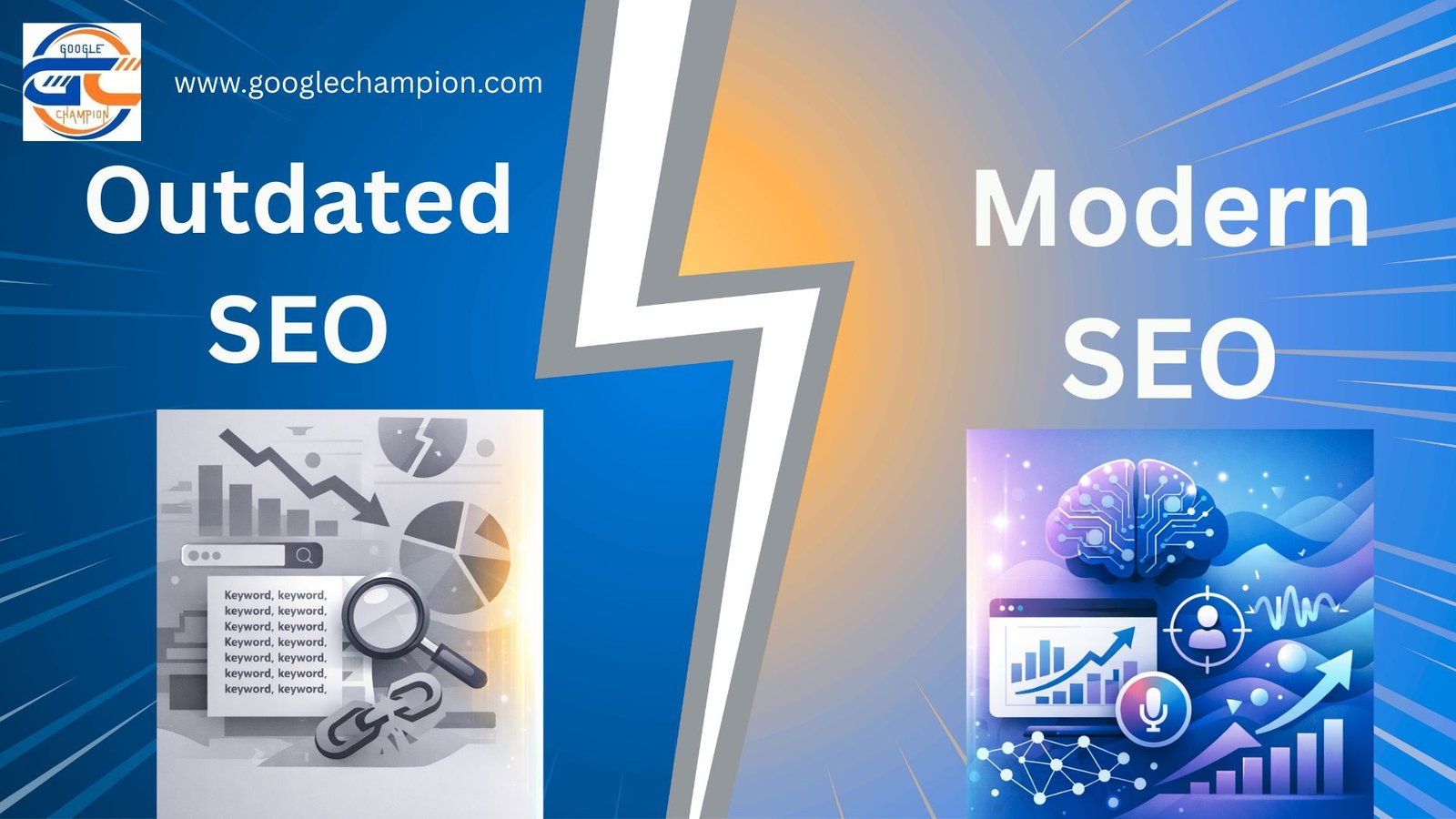

SEO is evolving faster than ever in 2026. As shown in the comparison above, the gap between outdated SEO practices and modern SEO strategies is massive. What worked before—like keyword stuffing and mass content production—is no longer effective.
Today, SEO is about user experience, intent, AI optimization, and brand authority.
If you want to improve your website ranking and stay competitive, understanding this shift is crucial.
Today, SEO is about user experience, intent, AI optimization, and brand authority.
If you want to improve your website ranking and stay competitive, understanding this shift is crucial.
What is Outdated SEO?
Outdated SEO refers to old techniques that focus only on search engines rather than users. These method were effective years ago but now lead to poor rankings or even penalties.
Common outdated practices include:
- Keyword-high content
- Low-quality blog posting
- Buying backlinks
- Ignoring user intent
- Focusing only on Google rankings
What is Modern SEO in 2026?
Modern SEO is a smarter, user-first approach that integrates AI, search intent, and brand building. It focuses on delivering value rather than just ranking.
Modern SEO includes:
- Optimizing for Google + AI tools
- Creating high-quality, experience-driven content
- Building brand authority
- Targeting user intent
- Improving engagement and transition
Outdated SEO vs Modern SEO
1. SEO & Branding
Outdated SEO: SEO is separate from branding
Modern SEO: SEO is enclosed in brand storytelling
Today, strong brands rank higher because they build trust and understanding.
2. Optimization Approach
Outdated SEO: Optimizing only for Google SERPs
Modern SEO: Optimizing for Google + AI answers
With AI tools growing, your content must be optimized for AI SEO optimization as well.
3. Keyword Strategy
Outdated SEO: search high-volume keywords
Modern SEO: Targeting intent and decision-stage queries
Modern SEO focuses on why users search, not just keywords.
4. Content Strategy
Outdated SEO: Publishing many shallow posts
Modern SEO: Publishing fewer, high-quality pages
Quality content now performs better than mass content.
5. Content Style
Outdated SEO: Generic “what is” content
Modern SEO: Opinionated, example-driven content
Unique insights help improve rankings and authority.
6. Content Structure
Outdated SEO: Keyword-heavy introductions
Modern SEO: Answer-first content
This helps in ranking for featured snippets and AI answers.
7. Page Optimization
Outdated SEO: Optimizing pages individually
Modern SEO: Building topic ecosystems
Creating clusters improves topical authority.
8. Content Updates
Outdated SEO: Treating updates as freshness hacks
Modern SEO: Updating context, examples, and relevance
Google now values meaningful updates.
9. Entity Optimization
Outdated SEO: Keyword maps without entities
Modern SEO: Entity + topic alignment
Entities help search engines understand your content better.
10. Traffic vs transformation
Outdated SEO: Chasing traffic only
Modern SEO: Driving revenue and decisions
Traffic without transformation has no value.
11. Success Metrics
Outdated SEO: Rankings as the main metric
Modern SEO: Visibility, leads, and citations
Modern SEO focuses on business results.
12. Link Building
Outdated SEO: Buying backlinks at scale
Modern SEO: Earning contextual mentions
Natural backlinks improve trust and ranking.
13. SEO Mindset
Outdated SEO: SEO as a checklist
Modern SEO: SEO as user satisfaction
User experience is now a key ranking factor.
14. Engagement
Outdated SEO: CTR tricks and clickbait
Modern SEO: Engagement and clarity
Useful content keeps users engaged longer.
15. AI Usage
Outdated SEO: Treating AI as a threat
Modern SEO: Using AI as a increasing tool
AI helps in content creation, research, and optimization.
16. Content Authority
Outdated SEO: Anonymous authors
Modern SEO: Visible experts (E-E-A-T)
Trust plays a major role in rankings.
17. Content Formats
Outdated SEO: Single-format content
Modern SEO: Mixed formats (text, visuals, guides)
Diverse formats improve engagement.
18. Data Tracking
Outdated SEO: Only Google Search Console
Modern SEO: Tracking AI remove and mentions
SEO now goes beyond traditional analytics.
19. Reporting
Outdated SEO: Reports full of benchmark
Modern SEO: Focus on visibility, leads, and ROI
Business outcomes matter more than numbers.
20. Off-Site Strategy
Outdated SEO: Ignoring communities
Modern SEO: use forums and social platforms
Communities now influence SEO performance.
Why This Shift Matters
The shift from outdated to modern SEO is important because:
- AI is changing how people search
- Users expect fast and correct answers
- Google prioritizes user experience
- Competition is increasing
If you don’t adapt, your rankings and traffic will drop.
FAQs
1. What is the main difference between outdated and modern SEO?
Outdated SEO focuses on keywords and rankings, while modern SEO focuses on user intent, AI optimization, and content quality.
2. Is keyword optimization still important in 2026?
Yes, but it should be natural and aligned with user intent rather than keyword stuffing.
3. How can I improve my SEO in 2026
Focus on high-quality content, optimize for AI search, improve user experience, and build authority.
4. Does AI impact SEO rankings?
Yes, AI plays a major role by influencing how content is discovered, ranked, and displayed in search results.
Conclusion
Old SEO focuses on search engines
Modern SEO focuses on users + AI
Old SEO chases traffic
Modern SEO drives transformation
Old SEO uses tricks
Modern SEO builds trust
To succeed in 2026, you must accept modern SEO strategies that prioritize value, intent, and experience.